Cryo-ablation

What is cryoablation?

Tumors can be treated with heating or freezing, this is also called thermal ablation or heat ablation. This heating or freezing causes the tumor to die. In cryo-ablation, the tumor cells die from freezing. After the ablation, the body cleans up the waste products itself, leaving a scar in the treated area. To carry out the treatment, the interventional radiologist inserts one or more needles into the tumour under ultrasound, MRI or CT guidance. This is done through a small puncture hole in the skin.

What does this treatment bring me as a patient?

Cryo-ablation can be used for a select number of smaller tumors in the kidneys, lungs, chest, prostate, abdominal cavity, soft tissue and/or bones. Cryo-ablation can also be used to make a larger tumor smaller or to reduce pain. This technique is used as a minimally invasive alternative to surgery or in patients who can no longer undergo surgery due to health problems such as heart, vascular and lung diseases.
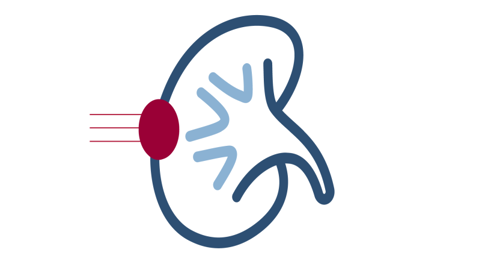

Illustration cryo-ablation

Learn more

The period before the treatment

Whether cryo-ablation is a suitable treatment option is discussed in the multidisciplinary consultation (MDO) with all doctors involved. The results of this MDC will be discussed with you by the attending physician.

If you are eligible for an ablation, you will be referred to the interventional radiology outpatient clinic, also known as image-guided oncological treatments (BOI). Here you will receive more information about the procedure. You often have an appointment for the pre-operative screening (POS) the same day.

The anesthesiologist will ultimately determine if you are fit and healthy enough to undergo this procedure. If this is the case, you will be placed on the waiting list.

The treatment on the day itself

In a cryo-ablation, needles are inserted in an image-guided way so that the correct position can be achieved. The needles are connected to a machine that presses liquid gas through a needle at high pressure, creating an ice ball at the tip of the needle. The ice ball that is created kills the cells.

Cryo-ablation is usually performed under general anesthesia. Sometimes epidural anesthesia (epidural) or sedation is chosen. This will be discussed with you by the anesthesiologist at the outpatient clinic.

The period after treatment

After an ablation, you will only see small incisions on the outside. However, on the inside of the body, the wound is larger and the body works hard in the first few weeks to heal this wound. How much you suffer from this depends on the size and location of the tumor. If you have recovered well enough, you can go home. In most cases, this is the next day.

What are the risks and side effects?

No procedure is without risks. When you are admitted to hospital, there is always a small risk of thrombosis (clot in a blood vessel), or an infection (e.g. pneumonia or bladder infection). With this procedure, there is also a small risk of bleeding, infection or damage to the treated organ, surrounding structures or the puncture route. This can be, for example, a disorder in kidney function, a urine leakage in kidney ablations, or a collapsed lung in lung ablations or ablations through the lung cavity.

In the first few weeks, you may experience the following side effects:

  • Fatigue
  • Pain at the level of the treated area
  • Nausea
  • Fluky feeling
  • Fever up to 38.5 degrees Celsius.

In addition, you may also have specific complaints of the treated organ or the puncture route. You can think of:

  • Coughing with or without blood (for ablations in the lung or through the lung cavity)
  • Urinate blood (in case of kidney or prostate ablations)
  • A numb feeling or painful perception of the skin.
onload